


The engineers, procurement professionals, and purchasers who need your capabilities are asking AI for supplier recommendations. If AI can't read your website, they can’t see you.
Tools like ChatGPT Search, Google AI Overviews, Gemini, and Perplexity now sit at the top of the funnel, synthesizing data, comparing vendors, and recommending solutions long before a buyer ever reaches your site. Technical researchers aren't typing “centrifugal pump manufacturer” into Google anymore. They’re asking questions like:
- Which pump manufacturers specialize in corrosive chemical handling?
- Compare epoxy coating services for high-torque components.
- Who are the top suppliers for 17-4 stainless machined parts?
AI responds by pulling from whatever websites it can read easily and trust fully. If your specs are buried in PDFs, your capabilities are trapped in JavaScript, or your content is structured in ways retrieval engines can’t parse, you simply won’t appear in those answers.
That means every industrial website now has a new job: be the clearest, most technically accurate, and most accessible source of truth in your category, for both humans and AI retrieval systems. If you don’t optimize your website for AI search engines, you risk being excluded from the conversations where engineers, operators, and procurement teams are making their first decisions about who to contact.
This article explains how to modernize your website for that reality, grounded in modern standards and practical development considerations.
Why Industrial Websites Must Evolve: Crawlers Collect, Answer Engines Curate
For years, SEO operated on a simple assumption:
- Search crawlers fetched your HTML
- Pages were indexed
- Rankings determined visibility
That world isn’t gone, but it’s no longer the whole picture. Here’s one way to look at it:
“Crawlers collect. Retrieval engines curate.”
AI systems rely on both traditional crawling and retrieval-focused analysis.
While AI answer engines like ChatGPT Search leverage existing web indexes (ChatGPT uses Bing’s index), they also use their own crawlers to make independent indexing decisions. AI systems don’t simply crawl and rank content like search engines do. They also:
- extract and classify language
- evaluate semantic clarity
- decide which passages answer which questions
- assemble those passages into synthetic responses
The key difference: traditional search crawlers focus on ranking content, while AI-focused crawlers prioritize synthesis and extractability. That means your content needs to be structured for both crawl-ability and extractability.
Your website’s structure, not just its keywords, also influences whether AI can understand and use it. This shift creates unique challenges for industrial brands, whose websites often rely heavily on:
- PDF spec sheets
- JavaScript-rendered data
- complex tables
- deeply nested divs
- image-based diagrams
- inconsistent terminology across product lines
These patterns break comprehension for AI retrieval systems — and can result in competitors being surfaced ahead of you simply because their content is easier to read.
Your content structure, markup, and HTML readability have never mattered more.
RELATED! Check out the other articles in our search visibility series:
- SEO Isn't Dead. It's Evolving. How B2Bs Can Stay Visible in the Age of AI
- The Content Marketing Checklist for AI-Era Search Visibility
- Lessons From the Front Lines: How Falcon Structures Rebuilt Industrial AI Search Visibility
The Industrial Website’s New Job with an AI-Driven Top-of-Funnel
The classic funnel assumed your website introduced prospects to your brand. Today’s AI-driven funnel looks different:
Today’s top-of-funnel discovery happens elsewhere:
- ChatGPT generating vendor shortlists
- Gemini explaining component differences
- Perplexity comparing specs and evaluating materials
- Reddit and LinkedIn for peer validation
- Supplier directories and buying hubs
Your website now serves these three critical roles:
1. The Authoritative Record
The place where both humans and AI confirm what’s true: specs, tolerances, certifications, materials, capabilities.
2. The Machine-Readable Source of Truth
Your site feeds the AI systems that shape buyer decisions about specs, explanations, and capabilities. If your data isn’t readable, it isn’t usable.
3. The Credibility Checkpoint
Buyers land on your site to validate the vendor AI mentioned. If your site feels messy, inconsistent, or outdated, trust collapses.
That means your website must be structured, readable, and technically sound enough for both humans and retrieval engines to trust it.
The AI Search Optimization Checklist for B2B Industrial Websites
Below is the complete set of standards your website must meet to remain visible in AI-driven search environments, tailored for B2B industrial realities. Think of this as your starting point for a new standard moving forward.
1. Clean semantic HTML (no “div soup”)
AI systems can’t infer meaning from arbitrary <div> structures. Industrial sites often bury key data inside layout boxes instead of structured tags.
Use:
- <article> for full pages
- <section> for content blocks
- <h1>–<h3> for real hierarchy
- <table> for real tabular data
- <figure> + <figcaption> for diagrams
- <ul> and <ol> for lists
- <p> for paragraphs
Avoid:
- Pages built entirely from <div><div><div>
- JavaScript-rendered spec sheets
- Important information trapped in accordions or hidden in hover states
Semantic HTML = higher comprehension for AI retrieval systems.
2. Make the “Reader Mode” Version Perfect
What’s visible is what’s valuable — so make sure your reader-mode view still tells your story. If your page collapses, disappears, or becomes incoherent when viewed in:
- Safari Reader Mode
- Chrome Distilled View
- Mobile reader view
…then AI retrieval engines see nonsense too.
Anything hidden behind:
- Animations
- Tabs
- “See more”
- JavaScript-only rendering
…is at risk of never being read. Reader Mode test = AI-readability test. Think of reader testing as testing for AI mode.
3. Put all critical information in HTML (not PDFs)
Avoid embedding critical information in images or image-based text; keep all important data in accessible HTML. Industrial sites often rely on:
- PDF spec sheets
- CAD files
- diagrams embedded as images
- safety sheets
- compliance documents
- “downloadable” content for core information
AI can’t reliably parse PDFs. Specs in downloadable files are typically specs excluded from retrieval.
While AI tools like ChatGPT and Claude can read well-structured PDFs when directly accessed, PDF specs aren’t as easily indexed for search and retrieval as HTML content. The issue isn’t AI’s ability to read PDFs; it’s that PDFs are less likely to be crawled and indexed in the first place, meaning they may never reach the AI systems that could otherwise synthesize and serve them up. So specs in downloadable PDFs are often excluded from retrieval.
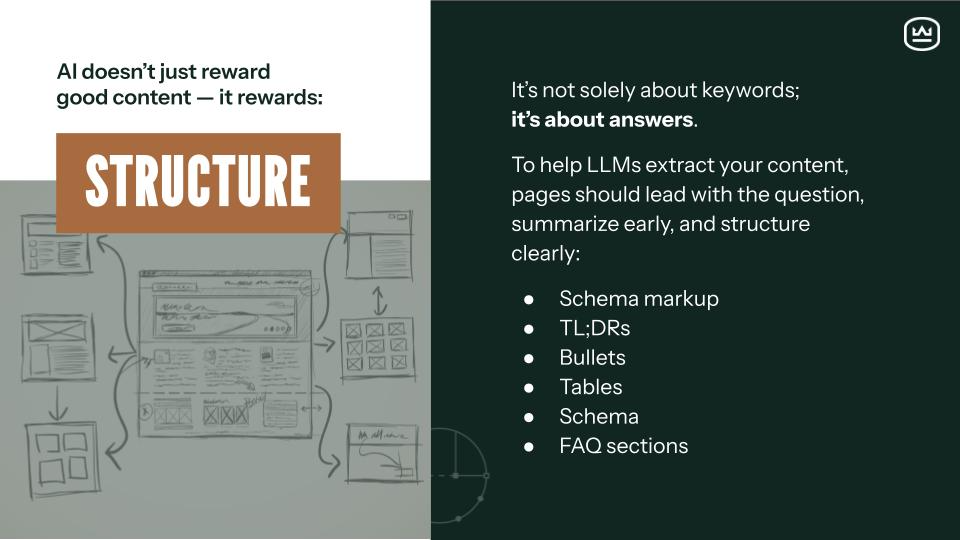
4. Front-load the most important information
AI summaries rely heavily on:
- the first heading
- the first paragraph
- the first 100 words
- the first table
- the first list
Start each section with:
- a clear, direct answer
- a short explanation or definition
- a measurable spec
- a summary statement
This is foundational AEO (Answer Engine Optimization) — the new SERP above the SERP. Help the model understand your information quickly.
5. Use question-based, descriptive headings
Engineering questions usually sound like:
- “Which materials are compatible with this application?”
- “How does this process compare to alternatives?”
- “What’s the operating temperature?”
Content structured around questions and answers maps directly to how engineers phrase AI queries. AI systems rely on headings to understand:
- topic boundaries
- context
- question/answer pairs
- relevance
6. Structured data everywhere — but don’t rely on it alone
Schema alone doesn’t make content visible; it only helps confirm the meaning of what’s already in plain HTML. Use schema to reinforce meaning — not to replace it.
“Schema is a trust signal, not a reader feeder.”
At minimum, implement:
- Organization
- Product
- FAQ
- HowTo
- Article
- Breadcrumb
Product schema is especially valuable for industrial audiences comparing specs.
7. Let the AI Bots Crawl Your Whole Site
Allow full crawl access to key pages for both search engine and LLM bots (Googlebot, GPTBot, Perplexity, Gemini). This means:
- no blanket disallows
- dynamic XML sitemaps
- validated indexing
- removing noindex from priority content
- no “security by obscurity” tactics
- allowing retrieval-focused bots (not just search crawlers) fetch pages
Important caveat: AI systems maintain their own indexes that don’t update immediately when your site changes. Critical updates like new certifications, changed specs, or updated capabilities may not appear in AI answers for days or weeks, even with full crawl access. Plan for this lag time when coordinating product launches or major announcements that depend on AI visibility.
8. Demonstrate real-world expertise
Industrial buyers rely on proof, not promises. For website content, that means demonstrating E-E-A-T (experience, expertise, authoritativeness, and trustworthiness) with original research and proof. Be sure to show things like:
- Application notes
- Certifications
- Test data
- Engineering credentials
- Manufacturing tolerances
- QC and QA processes
- Usage scenarios
AI and humans both need unambiguous signals that you know your craft.
9. Keep the site technically pristine
AI systems penalize websites that appear unreliable or unstable. Technical requirements include:
- clean canonicalization
- fast load times
- no redirect chains
- no broken JavaScript
- no rendering failures
- accessible mobile performance
- stable layout (Core Web Vitals)
A technically healthy website sends higher confidence signals, and that supports information retrieval.
10. Monitor Continuously, Not Annually
Industrial sites often see regular additions and changes:
- products evolve
- specs update
- certifications renew
- compliance requirements shift
Freshness is now a ranking factor for both search engines and AI models.
Site monitoring needs to be frequent and ongoing with weekly health checks, regular live updates, and timestamped content updates proving freshness. AI search references the most current version of your site — so it must always be current.
Why This Clarity Matters Now: AI is Changing How Engineers Ask questions
Simply put, AI is making searchers’ queries longer, more complex, and more unique. Engineers and procurement professionals now submit:
- Multi-step questions
- Context-rich comparisons
- Scenario-based troubleshooting issues
- Process- and capability-based queries
That’s the competitive threat and the opportunity. If your content isn’t structured to answer these kinds of questions, both humans and AI tools will choose competitors who are.
For Industrial Marketers, the Bottom Line is Simple
If you optimize your website for AI search engines, you’re doing more than improving rankings. You’re ensuring your expertise is actually visible where buyers begin asking questions.
If you don’t, you’re choosing invisibility in those answer engines.
Modern industrial websites have long since evolved beyond digital brochures or conversion funnels. Now, they’re the knowledge repositories that feed the AI systems shaping buyer’s decisions.
Your website isn’t just a marketing asset anymore. It’s part of the industrial buyer’s information retrieval infrastructure.
If you’re ready to see how visible your brand really is across Google, Gemini, ChatGPT Search, and the AI tools your buyers rely on, Weidert can help. Our Search Visibility Playbook gives you a clear scorecard of where you stand today, and a prioritized roadmap for what to fix first.


You May Also Like...

Website Design
B2B Website Investment: What the Higher Quote Buys


Website Design
Industrial Website Strategy in the Age of AI Search
Weidert Group News & Events
The Growth Engine Framework Presented at Manufacturing First | Weidert Group News