


TL;DR: What is a Growth Engine?
A growth engine is a connected system where every effort compounds on the last, creating momentum that doesn’t reset at the end of the quarter. Building one requires two things in sequence:
1. Four foundations that have to be in place before anything scales:
-
A clear brand and messaging standard
-
A documented growth playbook
-
Clean and connected data infrastructure
-
A website built to convert
2. Three always-on tracks that run continuously once the foundation holds:
-
Core market presence (the long-term compounder)
-
Activation sprints (targeted campaigns for surge capacity)
-
Operational optimization (the revenue ops that keeps the system from wearing out)
It doesn’t have to happen at once. Start with a foundation audit.
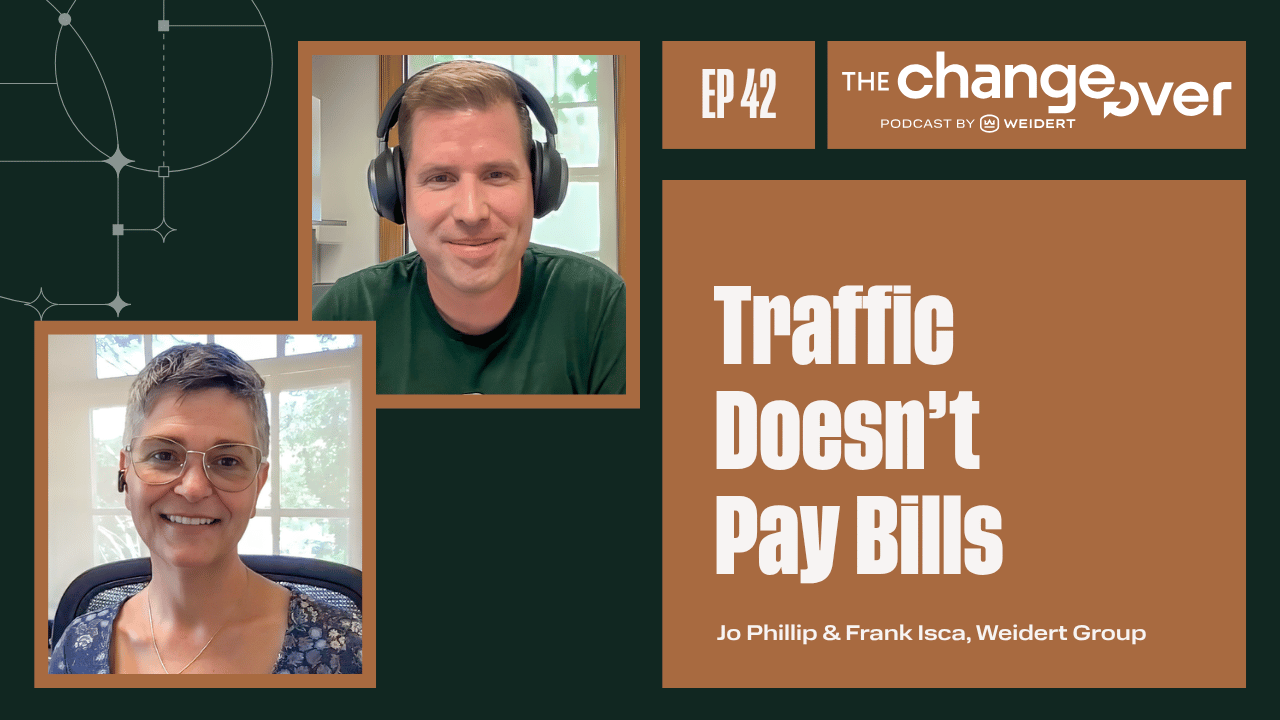
In a recent episode of The ChangeOver Podcast, Nicole Mertes and I make the case for moving from random acts of marketing to a systems-driven growth engine and answer the question: What does building a B2B growth engine actually look like?
In this episode, Nicole and I walk through the full architecture of a B2B growth engine: the four foundational pillars that have to be in place before the engine can run, and the three always-on operational tracks that keep it moving once it does. This is a practical blueprint — and if your program feels stuck, underfunded in the right places, or difficult to scale, it’s for you.
Watch the full conversation now or read on for an overview of Weidert’s growth engine approach.
Watch episode 35 of The ChangeOver, then subscribe on Apple, YouTube, Spotify, Weidert.com, or your favorite podcast app.
What is a Growth Engine?
Most companies market in bursts — a trade show push, a product launch campaign, a quarterly email blast. Each effort starts from scratch. When it ends, so do the results.
A growth engine works differently. It’s a systems-based marketing framework where every effort feeds into the next — replacing disconnected campaigns with a structure that builds momentum over time.
The difference from what most companies are doing: campaigns reset. Systems compound.
Here’s what that means in practice:
- Compounding results: Instead of starting from zero each quarter, a growth engine builds an asset base where visibility and pipeline value accumulate. The longer it runs, the more efficient it gets
- Continuous improvement: The system learns from performance data, refines messaging, and applies those learnings forward — so each cycle is better informed than the last
- Foundational architecture: Before the engine runs, the right machinery has to be installed: a consistent brand and messaging guide, a strategic growth playbook, clean and connected data infrastructure (including your CRM), and a website built to convert
- Always-on operations: Once the foundation is set, three interconnected tracks run continuously — core market presence (the long-term compounder), activation sprints (targeted campaigns for surge capacity), and operational optimization (the revenue ops that keeps data clean and systems aligned)
The mindset shift: most organizations are renting results, one campaign at a time. A growth engine is something you own — and it gets more valuable the longer you invest in it.
The Growth Engine’s Four Foundational Pillars
There’s an order of operations to building a growth engine, and it starts with foundations. Nicole and I cover four areas that are non-negotiable before anything else can scale.
1. Brand Positioning
The first pillar is arguably the most overlooked, and the one I see most companies assume they’ve already handled. Nailing your brand and style foundation means getting clear on how you talk about your point of difference, who you’re talking to, and what actually matters to them:
You could do all the marketing activities in the world, but if you don’t have this foundational piece dialed in — and a lot of companies think they have it figured out until we start asking questions — messages are typically not consistent across the organization.
This includes not just your visual identity, but your positioning and messaging standards (ICP, personas, value proposition, messaging hierarchy). It doesn’t necessarily mean a complete rebrand, but done right, it means every customer-facing touchpoint is aligned.
Getting here requires audience research: one-to-one conversations with customers, clickstream data on where your best buyers spend time and increasingly, AI-powered mining of your existing CRM data, sales call notes, and other unstructured data you’ve collected but maybe never used before.
In our experience, clients who end up with the strongest foundation are those who’ve taken the time to ask the right questions from the start, and then have committed to investing the hard work on a solid build.
2. The Growth Playbook
Once you know who you are and who you’re talking to, you need a strategic plan for how you’re going to reach them. Think of your growth playbook as your practical blueprint for:
- Search visibility strategy
- Content strategy and distribution
- Conversion paths and the sales handoff
- Lead nurturing for those not yet ready to buy
- Segmentation — so sales knows who is truly ready and who needs more time
- Reporting and KPI prioritization — so the data you collect actually gets used
Without a documented, standard structure around all these different engine components, teams default to executing on whatever gets requested most loudly.
Strategy is what gives you the strong spine to say “no” to the wrong things at the wrong moment, and invest confidently in the right ones. As Nicole put it:
If you don’t have an unlimited budget — and I haven’t met anyone who does — this is how you decide where to focus.
3. Data & Tech Enablement
This area gets deferred more than it should, and it’s something I see cause real problems down the line.
If scaling your marketing and sales is part of your goal (and it really should be, if you’re interested in improving your program’s performance and ROI), you’re thinking about deep personalization in your website’s user experience, email marketing, etc.
Performance is going to depend on defensible segmentation and accurate reporting. That all boils down to the state of your data, and the setup of your platform.
Data and tech enablement means a CRM that’s actually being used, data that’s clean and connected across systems, and the right hygiene practices in place to support personalization, segmentation, and reporting. This is the infrastructure upon which the operations depend. It’s just not something you can skip and come back to later.
4. The Website
The website gets its own pillar because it has a bigger job than most organizations give it credit for.
In a lot of cases, people all across the business depend on various pages of the website to do specific jobs — and often, those jobs haven’t been clearly acknowledged, understood, or mapped. They’ve just sort of grown organically over time, as websites have taken on a more prominent role in the marketing funnel and sales process. But think about it this way:
What job does each page of the website have to do?
What are your website’s specific conversion paths, knowing that users don’t always start their journey on your home page?
Nicole offered this mental model that I think industrial B2B marketers can relate to: Think of your website as a distribution center. It sorts demand, routes it, and converts it. Or it doesn’t … and you pay for that in leads that evaporate.
Website strategy, in this context, means planning for different entry points, designing for personalization at scale, and building the data flows that feed your sales team real intelligence about returning visitors and behavior patterns.
RELATED: How to Evolve Your Website from Traffic Magnet to Conversion Powerhouse
The Three Always-On Tracks
Once the foundation is in place, the growth engine runs on three distinct yet interconnected operational tracks — in parallel, continuously, indefinitely.
Track 1: Core Marketing Presence
In our conversation, Nicole referred to this as the great compounder. Track One encompasses everything that builds long-term visibility and authority: educational content, technical thought leadership, SEO and AEO, website conversion optimization, nurture programs, and brand consistency across channels.
Too many companies underfund this track, because quite frankly, it’s hard. It takes focus, dedicated bandwidth, and the discipline to not let this critical work get crowded out by urgent, time-bound campaign requests. Nicole’s line on this is worth taking seriously:
“Don’t under-invest in Track One and over-invest in Track Two.”
Because that’s often how it plays out. Underinvestment here almost always leads to unstable pipeline and reactive marketing.
But in our experience, companies that have made the strategic investment in Track One consistently find everything else easier. On the other hand, teams starting from scratch have to reckon with the reality that this track takes time and strategic thought to build — but that still doesn’t make it optional.
Track 2: Activation Sprints
Track Two is where most companies spend the majority of their marketing energy — and where they get into trouble when it’s the only thing they invest in.
Activation sprints are targeted, high-impact campaigns designed to generate near-term pipeline around a defined audience or revenue priority. Think trade show campaigns, account-based marketing campaigns, product launches, vertical expansion, or competitive response.
These campaigns are valuable, but they deliver their best results when layered on top of the core presence that Track One builds.
Without the Track One foundation (brand awareness built by an optimized core market presence), every sprint starts from zero. With it, each activation taps into an audience that already knows who you are.
Sprints also serve a second purpose: they test messaging, channel mix, and audience segments in real time. This generates fresh insights that make future campaigns sharper and smarter, informing and improving your ongoing roadmap.
Think of activation sprints as surge capacity — not a substitute for the system.
Track 3: Operational Optimization
Track Three is the revenue operations layer — the "intentional design and long-term preventive maintenance of the system," as Nicole put it.
It includes:
- Marketing and sales alignment — ensuring qualified leads are getting to sales efficiently, and that the definition of “qualified” is actually working
- Data and automation tuning — applying learnings from each campaign to improve the next one
- Website conversion optimization — iterating based on real behavioral data
- Reporting review — making sure KPIs are still true and the data is trustworthy
My summary of Track Three is it's the focused optimization that keeps your overall growth program running the way it should. If you build the infrastructure and never come back to it, it wears out. No one would ever do that with a critical asset on a production floor.
A sales and marketing growth engine should be thought of as a critical organizational asset that deserves ongoing care, maintenance, and upgrades to perform at its best. Most teams don’t dedicate attention here until something breaks — and that’s almost always a preventable problem.
Where to Start: The Foundation Audit
For marketing leaders who see this architecture and wonder where to begin, we recommend an audit of your foundation, starting with these four questions:
- Is your positioning and messaging consistent between marketing and sales, or does the conversation shift when a lead moves from campaign to the first sales call?
- Is your CRM functional and actually in use, by both Marketing and Sales?
- Is your website strategically built to convert, or is it still functioning more as a digital brochure?
- Is your content current and delivering true information gain for users, or has it been put on the back burner long enough that it’s stale and easily replicated by just about any AI?
You don’t have to answer yes to all four before you move. But you need to know where the gaps are before you start spending in the wrong places.
Mindset Shift Ahead: Progress Over Perfection
The biggest barrier to building a growth engine truly isn’t the complexity — it’s the false assumption that it has to be done all at once. That’s unnecessary.
A growth engine is built iteratively. What makes it a system rather than a series of campaigns is that each step compounds on the one before it.
For organizations that have been running on random acts of marketing, that compounding is exactly what’s been missing. And once you experience it, it changes how you think about marketing investment entirely.
The audit questions above are your starting point. Identify the gaps, prioritize the first fix, and build from there. Watch the full episode above and subscribe to The ChangeOver on your preferred platform to never miss an episode.


You May Also Like...
Website Design
B2B Website Investment: What the Higher Quote Buys


Website Design
Industrial Website Strategy in the Age of AI Search
Weidert Group News & Events
The Growth Engine Framework Presented at Manufacturing First | Weidert Group News