


Buyers now build their shortlist through AI assistants, peers and industry directories before they ever reach your site. That moves your website’s job from persuading to confirming, and it makes top-line traffic a poor number to plan or budget against. Below: what changed, what to check this week, and how to frame it for finance.
Your organic traffic is down. Somebody in a leadership meeting has already asked what marketing intends to do about it, and the honest answer is uncomfortable. The decline may not be a performance problem at all. Discovery moved.
As Director of Business Development, I sit across the table from industrial companies when the website conversation starts, and I ask every new prospect the same question: how did you find us? Nine times out of ten right now, the answer is ChatGPT, Claude or Perplexity. That one change rewrites industrial website strategy, from what a page is for, to how you defend the budget line.
In part one of our conversation on The ChangeOver, Jo Phillip and I worked through what actually changed. This is the short version, with the parts a marketing director and a CFO each need.
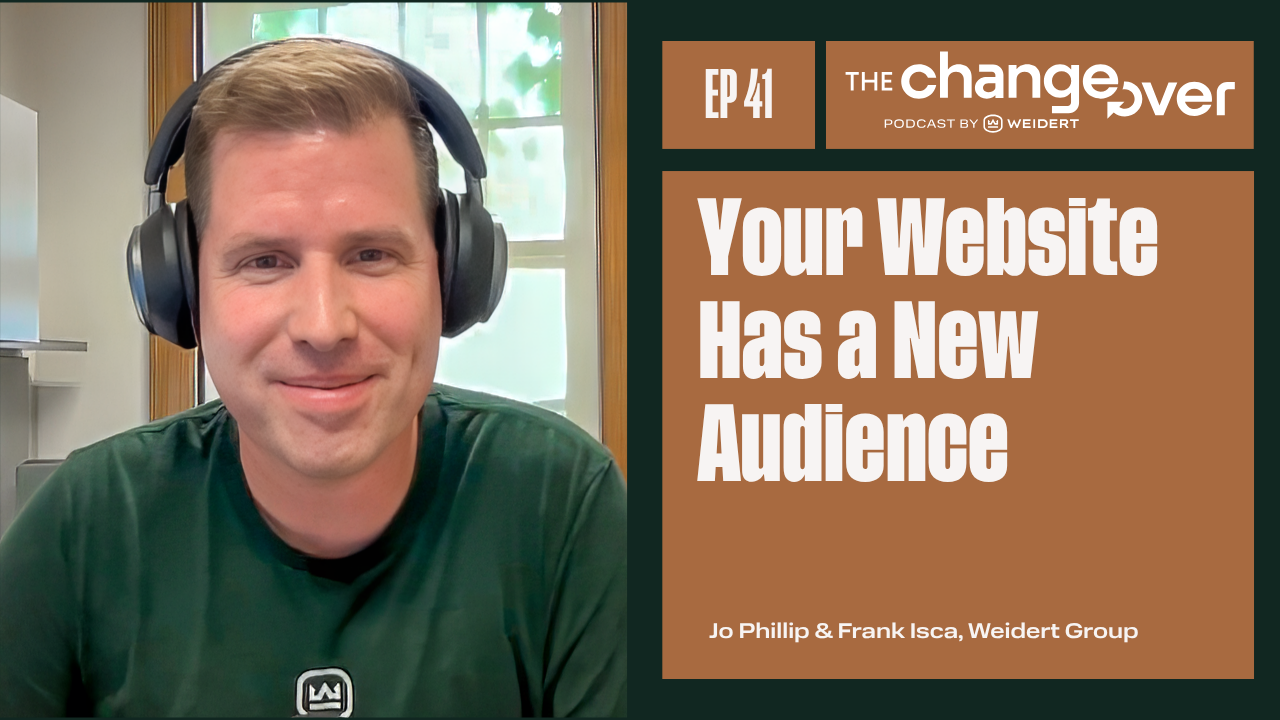
Watch episode 41 of The ChangeOver, then subscribe on Apple, YouTube, Spotify, Weidert.com, or your favorite podcast app. You'll be notified when part two of our conversation drops.
The Buyer’s Journey Went Dark
A few years ago, a form fill arrived vague and I filled in the rest from analytics. I could see the pages they read, the order they read them in, and roughly how long they had been circling. The record told me where the conversation should start.
Now the record is mostly empty. Prospects land on the homepage or go straight to the consultation page, and they convert inside a minute. Two or three pages, sometimes fewer. The form text is specific enough that it reads like it was drafted somewhere else, because it was. They arrive knowing what we do and roughly what it costs.
None of that evaluation happened on our site. It happened in a chat window, in a directory search, in a conversation with a peer, and we have no measurement of it at all.
“They might collect your name, which builds the awareness, and that might tweak the curiosity… but they might do all of that without ever showing up on your site. That really and truly is invisible until you hear about it.” — Jo Phillip
Why Is My Organic Traffic Falling While Direct Traffic Rises?
Because research relocated. Buyers investigate you through AI assistants, directories and peers, then type your company name or URL right into the browser. That arrives as direct traffic, not organic and not an AI referral. Falling organic alongside rising, high-converting direct traffic usually signals relocated research rather than lost demand.
The numbers behind that pattern are blunt. Bain found 85% of B2B buyers purchase from the day-one list they had in mind before they started searching. Forrester reports B2B companies seeing traffic declines of 10 to 40% over the past year, and buyers who use AI instead of search are roughly one-tenth as likely to click through to your site at all.
When you read these two findings together, they say something specific: the shortlist is being assembled in places you can’t measure, and the click you used to count so carefully was never where the decision was made, anyway.
Your Site’s Job Moved From Persuading to Confirming
Buyers used to arrive wide open, waiting on a conversation. Now they arrive with a claim in hand, given to them by an AI assistant, and they check whether your site backs it up. I hear some version of this on most calls now: "It’s very clear you know our space, you understand our industrial world." That’s a verification comment, not a discovery comment.
And that makes any contradictions they find between their AI experience and your website expensive in a way they never used to be. If your address, your leadership, your capabilities or your specialization read one way on ThomasNet, another on a niche engineering directory and a third on your own site, you pay for the discrepancies twice:
- The machine loses confidence in you as a source and cites someone else
- The human who does reach your site sees the mismatch and starts wondering what else is out of date
These details often decay behind the scenes as a business goes through acquisitions, product changes and staff turnover when nobody owns them explicitly. Right now, nobody owning them has a direct cost.
Every Page Now Answers to Another Kind of Reader
A human reader scans, decides in seconds and forgives a lot. An AI bot reads every word, never gets tired, and repeats back whatever it found. Vagueness that a person’s brain might fill in isn’t corrected by the machine. It reproduces all the vagueness it digested.
That’s why the old habit of holding back detail so competitors can’t copy you now works against you. If you’re not the one who published the specific answer, you’re not the company getting cited when a buyer asks the question.
“Think about the difference between ‘we offer flexible solutions for a range of industrial applications’ versus ‘we mill, blend and package [whatever type of product] in batches from this very small size to this specific very large size, bulk rail car volumes… with same-week turnaround on repeat formulations.’” — Jo Phillip
The second version is the same claim. The difference is that a machine can extract it, compare it and repeat it accurately, and a buying committee can act on it without having to call you first. Depth is where this shows up: specifications, tolerances, service areas, process, the work your company won’t take on.
It is also why secondary pages matter more than they often get credit for. Those deeper pages are the first thing cut when cost leads a website build conversation — and they’re the pages doing some of the hardest work.
But Can You Explain It to Your CFO?
Traffic was always a proxy metric. Now, it’s an even less valuable one, and defending a website investment with a traffic chart invites a losing argument. If I were walking into a budget review, I’d carry these three framings in with me:
-
Count pre-qualified opportunities, not sessions. How many inbound conversations this quarter opened with the prospect already knowing what you do and roughly what you charge? That number rose for us while organic fell. This is the number that maps to sales cycle length and close rate.
-
Ambiguity has its own price. Absence from a shortlist isn’t going to show up in most reports available to you. It appears as a quarter with fewer at-bats and no obvious cause. Specific, published, consistent information is what gets you onto the day-one list, and 85% of purchases come from that list.
-
Treat the site as the receiving end of your revenue operations. What the form captures, where the record lands, who gets notified and what sales sees on arrival is what turns a website visit into pipeline. With less visible journey data available, first-party capture is worth more, not less.
Two Things to Check This Week
Neither requires budget approval or a vendor conversation. Both will show you something important about your website.
-
Separate machine traffic from human traffic in GA4, then look at direct honestly. If direct is climbing while organic falls, buyers are finding you somewhere you’re not measuring, and your reporting is describing as a decline what’s more accurately described as a shift.
-
Ask your 10 most recent converted leads these two questions: "How did you find us?" and "What did you already know before you reached out?" Those answers could tell you more about your current demand than your website dashboard can right now.
The diagnosis of what needs to be done is the easy half. Every page now answers to a person and a machine, buyers arrive already decided, and your analytics can’t see most of what formed their decision.
What none of that tells you is what to build in response, or why one proposal says $30K and another says $70K.
That’s what we cover in the second half of the conversation — where you see the difference between what it takes to build a new site and what it takes to build a site that’s foundational to your marketing infrastructure. If a website is on next year’s budget, it’s an understanding worth having before diving into the numbers.
Subscribe to The ChangeOver Podcast
Catch part one now, and subscribe on Apple, Spotify, YouTube or the Weidert Learning Center so part two lands when it drops.


You May Also Like...
Website Design
B2B Website Investment: What the Higher Quote Buys

Website Design
Industrial Website Strategy in the Age of AI Search
Weidert Group News & Events
The Growth Engine Framework Presented at Manufacturing First | Weidert Group News