


Two proposals for the same industrial website can differ by 50% or more because they are priced against different scopes of strategic decision-making, not different amounts of production. The cheaper quote doesn’t remove that work; it moves it past launch, where it costs more and ends up in a different budget. The strategic audit line item that raises quality and lowers the total investment is the one too many marketers try to cut.
If a website refresh is in your near future, sometime soon you’ll likely put two proposals in front of the person who controls your marketing budget. One says $35,000. The other says $70,000 or more.
On their faces, they appear to describe what looks like the same finished product, and the person reading them has no way to see what accounts for the pricing gap.
Adjectives aren’t enough to defend the higher number in a budget conversation. You need to be able to explicitly describe what the money is buying — and what the cheaper option leaves out. Frank Isca, our Director of Business Development, sits on the sales side of this exact conversation. In part two of our discussion on industrial websites we talked through how to make a B2B website investment legible to a CFO who's comparing line items.
It’s a conversation worth bringing into your own budget meeting. (If you missed part one, we covered Industrial Website Strategy in the Age of AI Search.)
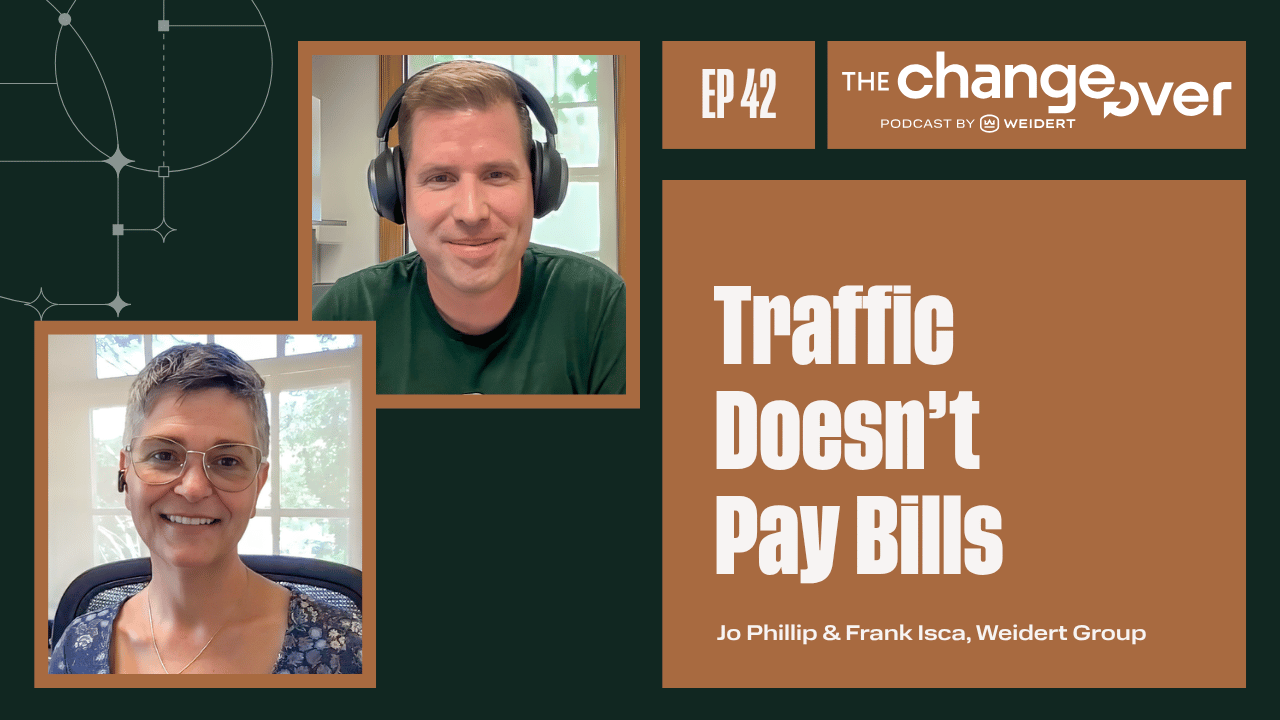
Watch episode 42 of The ChangeOver, then subscribe on Apple, YouTube, Spotify, Weidert.com, or your favorite podcast app.
Why Does One Website Proposal Cost $35,000 and Another $70,000?
The lower number buys page builds. The higher number buys the sales and marketing decisions that determine which pages are worth building:
- What job each page is accountable for
- Which conversion paths exist and who validates them
- What migrates from the old site
- How the site works with the CRM to give Sales a workable pipeline
AI makes production cheaper. It doesn’t replace the strategy that determines what to produce.
“That $30K is going to get you pages… the $70–80K, that’s strategic decisions, that’s technical performance, and pages.” — Frank Isca
Here, it’s worth being precise about what those decisions cover, because the list is longer than most buyers expect: How the site is wired to the CRM; whether paid campaigns have pages built to turn them into leads; what an engineer three levels deep in a spec page is supposed to do next (given that the engineer is rarely the person who finally requests the quote); which crawlers you allow; how navigation works for buyers who won’t enter via your homepage.
With purpose or by default, every one of those is a choice somebody makes.
A Cheaper Quote Relocates and Defers Work
This is work you can’t just skip on a website, especially for complex industrials working long sales cycles and buying committees. This is the piece finance can easily grasp, because they’ve already seen it in capital projects.
The cost not spent in planning doesn’t disappear. It bubbles up later, often larger, and on a different budget.
A site that ships without strategic decisions made timely still needs them made. The difference is that it now happens after launch, in remediation, on a live property, while the pipeline runs through it. Six months of underperformance isn’t a project cost. It becomes a revenue cost. You don’t see that on a proposal, but you will see it in website performance — which translates to more than lost traffic. It’s lost trust, authority, and pipeline.
Ask what a month of degraded lead flow is worth against your average deal size and close rate. For most industrial companies, that number settles the proposal comparison faster than any list of website features.
The One Line Item That Can Lower Your Website’s Total Cost
In our conversation, Frank described a conversation with a marketer who wanted a straight migration to HubSpot. Same content, new platform, minimal fuss. The quote came back above their budget, because moving a decade of accumulated pages correctly is labor no toolset can eliminate.
So the question changed from how much it cost to migrate, to whether all of it should even be moved. By pulling metrics and looking critically at what each page was achieving, we were able to scope the migration down by roughly 40%.
That sequence inverts the usual assumption. The strategic work reduced the total invoice. Everything else in a website proposal adds to the number. A strategic audit can actually subtract from it. Even so, it’s routinely the first item a cost-focused buyer wants to cut.
But here’s the issue: that legacy content carries two costs and most companies only pay attention to the first. You have the acquisition cost of migrating a page, which is labor. But there’s also the carrying cost of keeping it — which is what it does to your authority, your navigation, and your topical coherence for as long as it continues to exist.
You won’t see the second set of costs on a spreadsheet, but it’s real and you’ll experience it in marketing and sales results.
Website Traffic Without Revenue Is Inventory You Pay to Store (and Will Never Use)
Nearly every site we inherit in rebuilds has two or three legacy, old-school SEO blog posts pulling significant traffic. They end up being pages nobody wants to touch, yet on close inspection not one of those visitors has ever been connected to revenue.
Until recently, that was merely wasteful. Now it’s worse. AI crawlers arrive having already built a picture of who your company is from everything else they’ve read about you. Content that contradicts that picture, covers a topic that’s adjacent at best, describes a product you discontinued, or speaks in positioning you abandoned three years ago doesn’t sit there harmlessly. It weakens the coherence of the entity the AI machine is building about you, at the exact moment machine descriptions are how buyers build shortlists (i.e., in detailed chats with AI assistants).
To translate into finance’s lexicon: a page that ranks but never converts is inventory you pay storage on. And storage just got a lot more expensive.
Where Does Website Strategy’s ROI Show Up?
If your website is a point where marketing hands off to sales (and it should be), then the return is measurable at the handoff rather than at the visit. That’s a more defensible argument to your CFO. It also happens to be where a lot of B2B website investment gets redlined, so it never gets a chance to do its work.
Think about form and chatbot strategy: what you capture, where and how the record lands in the CRM, who gets notified, and whether the person picking it up has enough data to prioritize their next steps. A well-qualified sales lead sitting in an inbox instead of the CRM is a lead your team is paying to generate, and then paying again to chase down.
Data enrichment changes the math even further. Industry, region and firmographics can be captured on the back end, so the form can get shorter while the record gets richer. That means the visit delivers a better UX and less friction for your buyer, and more context for your sales team. All at the same time.
Here are three values to consider in that budget review, none of which are website session numbers:
- Time from conversion to first meaningful sales contact. Routing and enrichment impact this directly.
- Share of inbound conversations that open already qualified, where the prospect knows what you do and roughly what you charge.
- Cost of carrying content that produces traffic and no pipeline, priced as migration labor plus the authority drag it creates.
Where AI Lowers Costs, and Where Its Impact Isn’t Positive
The obvious question is on every buyer’s mind right now, and it deserves a straight answer. For a startup, a small business, a few pages that need to get online, an AI builder can be a reasonable choice. Frank drew the line at business complexity:
A $200 million manufacturer in a competitive space, with multiple audiences, technical specifications, a buying committee, and a CRM the site absolutely needs to talk to, is very unlikely to reach growth targets on an AI-generated site.
The reason is mechanical. It’s in the nature of what AI is made of. These tools produce the most probable output: layout, headlines, path from a spec page to a form, content phrasing. Probable is fine when you’re just trying to look legitimate. It works against you when the job is to look like nobody else in your category.
You can test the concept in about 90 seconds. Pull up your three closest competitors, mentally swap the logos, and ask whether a stranger could tell which is yours. If the answer is no, the probable option is already there. That’s what AI ingested, and that’s what it’s likely to regurgitate.
That’s not to say a legitimate website shop won’t use these tools. We do, constantly. For example, our dev team built an agent to handle image sizing and alt tags across a large site — work that would consume a week of human time, in just a few hours. Crawling and auditing at volume, bug diagnosis, the tedious high-error tasks: AI is making all of it more accurate at a lower labor price. When tedium and analysis cost less, more of a website budget can actually go to the strategic decisions, and the total can be less, not more than it would have cost a few years ago.
But what doesn’t move is the work people still do best. Positioning, page jobs, conversion logic, SME knowledge capture for content, and whether the design is on brand are human calls, and they’re the calls that determine whether the build earns its keep.
Ask These Three Questions Before You Compare Proposals
Ask every partner the same three, and listen closely for whether they have an opinion (and a process for it). The answers separate a website build from planned marketing infrastructure faster than a line-item comparison can.
- Who decides what job each page is accountable for, and can they state it in one sentence? If the answer is that your team will decide, the hours you’ll need to do it are part of your price.
- Who validates the conversion paths, and against what? A contact form at the bottom of every page is not a strategy. It’s a page template. An engineer gathering specs for a buying committee is not ready to request a quote — treating them as though they are risks losing them the moment you get their attention.
- What happens six months after launch? Not bug fixes. What’s the plan if the data says people are reaching the right pages and not raising their hand? What’s the plan for adding content later without amassing a mess like the one you just cleared out?
A website’s not a capital project that concludes at launch. It’s operating equipment that runs continuously on your behalf. Equipment gets a maintenance plan, a performance baseline and a line in next year’s budget. Nobody in your plant would install a new line and then agree not to look at it for three years.
The part of a website that got cheaper to produce and the part that determines whether it works are two different things. One shows up on the invoice as a difference, and it’s the one worth making the case for.
If you missed the diagnosis, start with part one, then subscribe on Apple, Spotify, YouTube or the Weidert Learning Center.


You May Also Like...
Website Design
B2B Website Investment: What the Higher Quote Buys

Website Design
Industrial Website Strategy in the Age of AI Search
Weidert Group News & Events
The Growth Engine Framework Presented at Manufacturing First | Weidert Group News