


AI search tools answer buyers’ questions about your company using every listing, profile, and mention they can find. When those sources disagree, the answer can be wrong in ways that cost you deals. An entity audit finds and fixes those contradictions. It belongs at the start of any core market presence plan, because everything you build later depends on the basic facts being right.
When a prospect tells you “everybody in our industry knows us,” they’re usually right — at least for now. The buyers who learned your name years ago are reaching retirement age today, and the people replacing them ask ChatGPT, Claude, or Gemini before they ask a colleague. Those tools assemble an answer from every directory listing, profile, and mention of your company, and most companies have never audited that record. An entity audit is how you find out what it says.
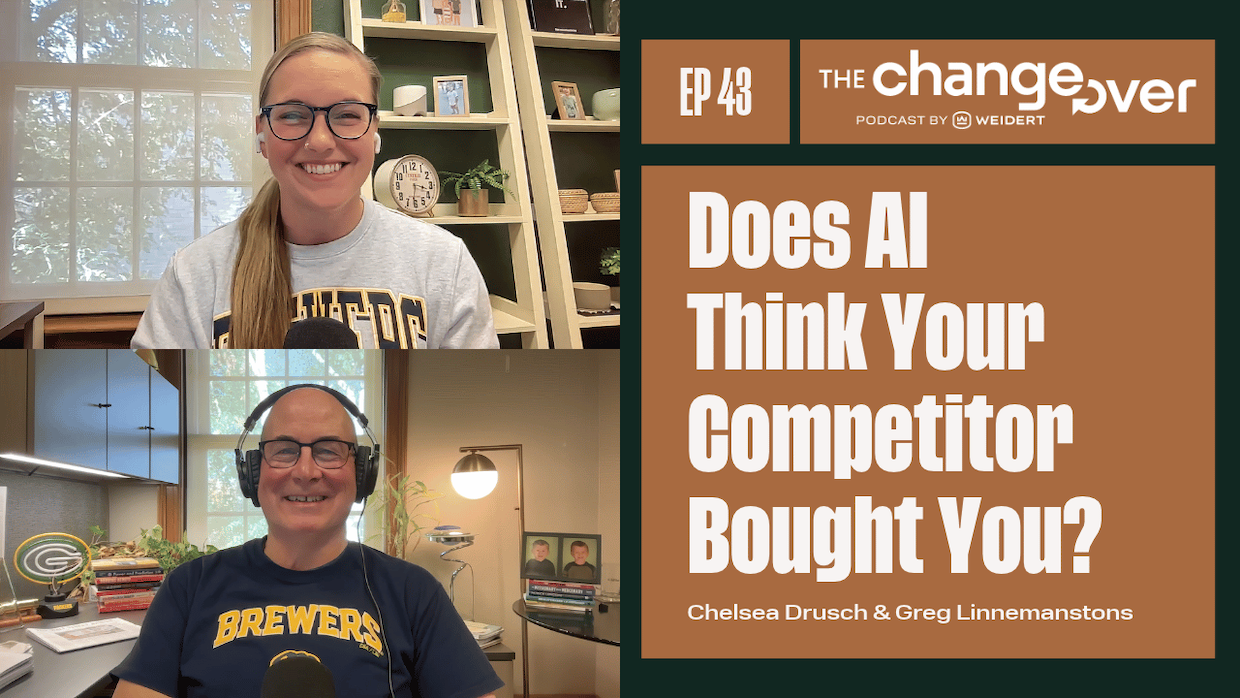
I sat down with Chelsea Drusch, Vice President of Marketing and Sales Growth Solutions at Weidert Group, for the entity conversation on The ChangeOver Podcast.
Chelsea’s work includes deciding what goes into a client’s core market presence. Watch the episode to see just what the audit can turn up, what ignoring it costs, and how to tell whether your work is paying off.
Watch episode 43 of The ChangeOver, then subscribe on Apple, YouTube, Spotify, Weidert.com, or your favorite podcast app.
Why “Everybody Knows Us” Stops Being True
Chelsea’s response to the “everybody knows us” claim is that it’s usually temporarily true. Two forces end it.
The first is people. Many of the customers who know your business are nearing retirement, and counting on them to pass your name to their successors is a risky bet.
The second force applies to every company regardless of its customer roster: AI search tools now sit between you and your prospects, and they read everywhere.
“It didn’t used to really matter if your ThomasNet directory listing had the incorrect phone number in it, because a very small portion of your actual human audience might go there. But now robots that are the intermediary serve that information to your actual human prospects via AI-driven search.” — Chelsea Drusch
A human researcher checks three or four sources and moves on. An AI tool has the capacity to check all of them, and the obscure ones can end up in part of the answer your prospect gets back.
What Is an Entity Audit?
But first, what’s an entity? In short, an entity is any definable thing: a company, a person, a product. AI search looks for consistent signals about each one. When 20 sources describe your company one way, 30 describe it another way, and a few say something decidedly off-base, the tool has no reliable basis for picking a winner.
In Chelsea’s words, “it doesn’t know what the truth is because it doesn’t know who holds the source of truth.”
An entity audit checks what the internet, and the AI tools that read it, say about the basic facts of your company: ownership, leadership, location, contact details, and what you sell. It identifies where those facts conflict across websites, directories, profiles, and LLM answers, so you can correct the record at the source.
Weidert’s audit runs in two passes:
- Find where your buyers actually go. Clickstream analysis from SparkToro helps us understand which platforms and sites your real audience uses. That covers the obvious places, like your Google Business Profile, your own website, Clutch, G2, Wikipedia, and Wikidata — and it also surfaces niche sources you might not know to check.
- Ask the machines directly. Weidert runs a large set of identity prompts through a tool we built to test LLM responses, such as “What is XYZ company?” and “Who is the current president of XYZ company?”
Chelsea’s verdict on what comes back: “You really quickly find out that it’s a hot mess.”
RELATED: Stop Chasing Clicks, Start Creating Value: The Marketer's Guide to Winning the Zero-Click Future
What Contradictory Facts Cost a B2B Company
One extreme case from Chelsea’s work came from an identity query for a client. The answer about who owned the company said it had been bought out by its biggest competitor. Spoiler: it hadn’t.
“So you could literally have a prospect doing research about whether you’re someone they want to buy from and [the inaccurate AI answer] could push you to your direct competitor.”
Most companies won’t find a fabricated acquisition. They’ll find smaller, insidious kinds of damage: a new product line missing from the answer, an outdated phone number that adds friction for a ready buyer, or responses with flat or negative sentiment because the company’s review base is sparse.
In those cases, Chelsea says, the tool ends up “either spitting facts or maybe giving them warnings if it found negative reviews.” Nothing in an answer like that gives a buyer a reason to call.
Do You Have to Fix Everything Everywhere?
Two complications keep this from being a simple cleanup project. First, each LLM favors different sources, so a correction that improves one tool’s answer may do little for another. Solving for all of them at once is sometimes impossible. Second, your buyers may not have a choice of tools. For example, in a strict Microsoft shop, employees might be allowed to use only Copilot.
That’s why audience research helps determine where the critical work needs to focus. Basic hygiene, like consistent facts and pages read easily by bots, will become standard practice.
“Everyone’s eventually going to be doing all that as a standard. The leg up then is in understanding where to invest more heavily in the specificity around exactly where it matters most to your audience.” — Chelsea Drusch
An entity audit often surfaces more opportunities than any budget can realistically cover. Chelsea described a typical finding: buyers debating pyrometry in an industry forum, a wrong Wikipedia entry, a weak YouTube presence, all competing with investments in campaign work, maybe also a trade show everyone in a given industry attends. Her advice is to weigh the potential impact and let some go entirely. In that scenario, she might skip the forum and commit to YouTube, because it serves more goals at once.
RELATED: Audience Research in the Age of AI: Turning Data into Marketing Advantage
Three Filters for Deciding What Makes the Plan
Chelsea calls these “the same decisions we’ve asked them to make, but they have higher stakes.” She runs every candidate through three filters:
- Start with current business goals. Ask what the business needs most right now that marketing can influence. If marketing doesn’t support the sales numbers, budgets shrink and nothing else matters.
- Weigh audience influence. Identify where you can reach buyers with the most influence, and what they care about enough to change their behavior.
- Compare effort against return. Include your realistic execution capacity in that consideration. A good idea without the processes, people, and buy-in to deliver it well won’t pay back.
Core Market Presence Determines How Effectively Campaigns Work
What do you say to a CMO who wants quarterly lead campaigns and resists putting most of the budget into work that won’t produce leads right away?
Chelsea’s answer is that campaigns depend on core market presence more than most people assume, because buyers rarely stay on the path a campaign builds for them. They wander. They might read your InMail, then ask Claude who you are, run a Google search, or forward the message to a trusted colleague.
“If you ignore the core market presence work that makes sure that when somebody strays off your path, your message is corroborated by what they find, then your whole campaign might not do anything.”
The client from the audit example is attacking both tracks. On the core market presence side, the team is correcting facts across the Google Business Profile, forums, directory listings, the website, and employees’ LinkedIn profiles. The audit also turned up a trademark collision with another company whose name overlaps, which is now its own workstream.
A second query set compared how AI tools describe the client’s offerings against competitors, and the biggest gaps became the priority list for new content hubs on the website. Meanwhile, if leads are below target and need an assist, the market activation track can focus on paid ads and better landing pages to convert that traffic.
This work is in progress, so it isn’t a results story yet. But it demonstrates the tension every roadmap meeting runs into between long-term work and pressure for leads this quarter. We can set the expectation of that conflict up front, so it becomes a planned trade-off, not a surprise.
RELATED: How to Optimize Your Website for AI Search Engines: A Practical Guide for B2B Industrial Brands
How to Measure Core Market Presence Before Revenue Gains Start Appearing
A CEO who funds this work in January needs to know by June whether it’s having an impact. The earliest signals are qualitative. In some of our own sales conversations, Weidert’s prospects have mentioned information they found about us through ChatGPT and Claude. At a client I work closely with, frontline staff reported that leads were arriving further along in the buyer journey. Volume didn’t spike, but the leads were better educated and better qualified, and moved quicker to close.
The measurable indicators follow buyer behavior. Most people still don’t click links in an AI answer. As Chelsea put it, “They just read the answers they get out of an LLM and then they go and Google the company.” So watch for:
- Growth in direct traffic
- Growth in branded organic search traffic
- AI referral traffic, which will become more useful as attribution improves but remains a minor path today
- More qualified leads over the long term
Tracking specific AI queries is harder than tracking keyword rankings, because the tools are probabilistic. In a study of nearly 3,000 runs of the same prompts, SparkToro and Gumshoe.ai found less than a 1-in-100 chance that ChatGPT or Google’s AI would return the same brand list twice. The authors suggested measuring how often a brand appears across many runs rather than its rank in any single answer. Read AI visibility data as one correlation indicator among several.
Chelsea’s shortcut for the long term: “if you’re getting an increase in qualified leads, keep doing what you’re doing.”
RELATED: SEO Isn’t Dead. It’s Evolving: How B2Bs Can Stay Visible in the Age of AI
Who Should Wait
Chelsea called out two exceptions that might not get the same bang for their entity work buck. The first is a highly regulated or deeply specialized market, such as parts of food, healthcare, or legal, where buyers rely on their own trusted sources rather than the open web. The other is an organization that sells mostly through RFP portals with verified vendor lists — for example, government buyers. Outside those cases, she says, “it’s going to be an everybody thing.”
If you take one step this quarter, make it the entity audit. Chelsea didn’t hesitate when I asked for the first move.
“100% an entity audit. Because anything else you do beyond that could be hampered by inaccuracies in some of that basic information, and it’s not a big investment to fix.” — Chelsea Drusch
Fixing your facts is the floor. In our next conversation, Chelsea and I will get into what you build on top of that core market presence: market activation campaigns, and why so many companies end up paying for the same awareness twice. Listen to the full Part 1 conversation above, including how Chelsea weighs one LLM against another.
Subscribe to The ChangeOver to be notified when part 2 drops.


You May Also Like...
Search Visibility
Entity Audit: Fix What AI Search Says About Your B2B Company


Website Design
B2B Website Investment: What the Higher Quote Buys

Website Design
Industrial Website Strategy in the Age of AI Search